How many Japanese verbs do you know? When you know the 100 most common Japanese verbs and understand basic Japanese verb conjugation, you can express and understand Japanese much better!
Verbs are one of the most important parts of speech in Japanese. Learning common Japanese verbs gives you the building blocks you need to talk about actions, thoughts, feelings, and everyday activities.
It’s always a bit tiring to learn Japanese grammar, such as the conjugation patterns of verbs. However, it’s easier than you think! Once you have the rules down and become used to using them, all you have to do is apply those rules to new Japanese verbs you learn.
Japanese verb conjugation follows different rules from English. But don’t worry! Some features are simpler—Japanese verbs do not change based on the speaker’s number, gender, or grammatical person, called 人称 (ninshō). This means that in English, verbs change based on who’s speaking:
- I am
- She is
- You are
- I go
- He goes
However, Japanese verbs remain the same regardless of who the speaker is.
In this article, we’ll introduce 100+ common Japanese verbs for beginners. We’ll also give you some tips about Japanese verb conjugation. Let’s master Japanese verbs here at JapanesePod101!
 Table of Contents
- Verb Groups: Different Types of Japanese Verbs
- Common Japanese Action Verbs
- Mental and Emotional Japanese Verbs
- Other Common Japanese Verbs
- Japanese Auxiliary Verbs: 助動詞 (Jodōshi)
- Japanese Verb Forms and Conjugation
- Conclusion: How JapanesePod101 Teaches You Japanese
1. Verb Groups: Different Types of Japanese Verbs
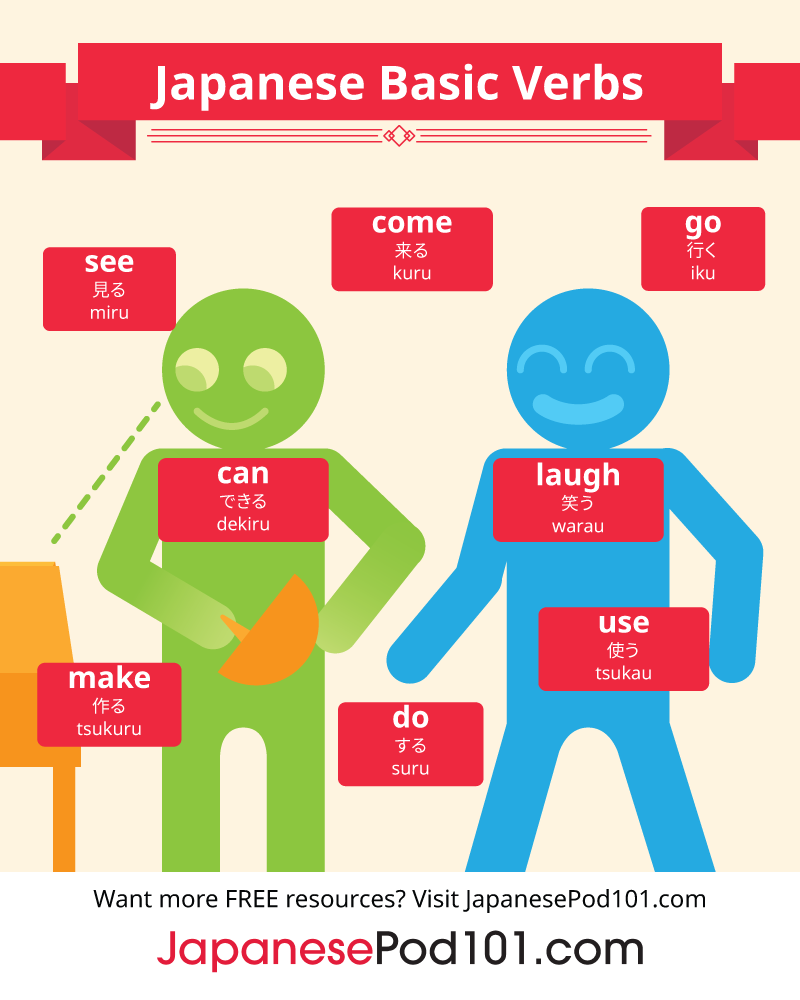
In their dictionary form, Japanese verbs end with a kana from the “u” sound row. Common endings include う, く, ぐ, す, つ, ぬ, ぶ, む, and る. However, not every verb ending in る is a Ru-verb, so learners must check the verb group when learning conjugation patterns.
- Class 1: U-verb
- Class 2: Ru-verb
- Class 3: Irregular verb
As the conjugation system itself is fairly regular, memorizing the main patterns and rules will help you learn how to use Japanese verbs properly.
Many Japanese verb forms can be understood as a stem followed by an ending. The ending changes according to the form, including casual, polite, plain, and negative forms. Irregular verbs such as 来る and する have additional stem changes.
Japanese U-Verbs: Godan Verbs
| 書く (kaku): write | Casual | Polite |
| Stem | kak | |
| Basic Form | 書-く kak-u |
書-きます kak-imasu |
| Negative Form | 書-かない kak-anai |
書-きません kak-imasen |
The verb 書く (kaku), meaning “write,” can be analyzed as the stem kak plus an ending. As you can see from the Japanese verb chart above, the ending changes depending on the grammatical form.

U-verb Examples
| English | Reading | Kanji | Hiragana |
|---|---|---|---|
| meet | au | 会う | あう |
| learn | manabu | 学ぶ | まなぶ |
| push | osu | 押す | おす |
| pull | hiku | 引く | ひく |
Japanese Ru-Verbs: Ichidan Verbs
| 出る (deru): come out | Casual | Polite |
| Stem | de | |
| Basic Form | 出-る de-ru |
出-ます de-masu |
| Negative Form | 出-ない de-nai |
出-ません de-masen |
The verb 出る (deru), meaning “come out,” has the stem de. For Ru-verbs, る is removed before many conjugated endings are added.
Ru-verb Examples
| English | Reading | Kanji | Hiragana |
|---|---|---|---|
| teach | oshieru | 教える | おしえる |
| exist (living things) | iru | いる | いる |
| sleep | neru | 寝る | ねる |
| answer | kotaeru | 答える | こたえる |
Irregular Japanese Verbs
Don’t worry too much! The two main irregular Japanese verbs beginners need to learn are 来る (kuru), meaning “come,” and する (suru), meaning “do.”
Unlike regular U-verbs and Ru-verbs, these verbs have irregular stem changes when conjugated. Since you’ll use both very often, it’s worth memorizing their main forms.
- 来る (kuru): come
| 来る (kuru): come | Casual | Polite |
| Stem | ku / ko / ki | |
| Basic Form | 来-る く-る ku-ru |
来-ます き-ます ki-masu |
| Negative Form | 来-ない こ-ない ko-nai |
来-ません き-ません ki-masen |
- する (suru): do
| する (suru): do | Casual | Polite |
| Stem | su / shi | |
| Basic Form | す-る su-ru |
し-ます shi-masu |
| Negative Form | し-ない shi-nai |
し-ません shi-masen |
The Japanese verb する (suru), meaning “do,” is a very useful verb that can combine with many nouns to form verbs.
For example:
- 勉強 (benkyō) + する (suru) = to study
- 参加 (sanka) + する (suru) = to participate
- 感謝 (kansha) + する (suru) = to thank / appreciate
Now that you have a better idea of how to conjugate different types of verbs, let’s move on to our Japanese verbs list!

2. Common Japanese Action Verbs
Here are common Japanese verbs for movement, daily activities, and other physical actions.
| English | Japanese Reading | Kanji | Hiragana |
|---|---|---|---|
| see / look / watch | miru | 見る | みる |
| hear / listen | kiku | 聞く | きく |
| say | iu | 言う | いう |
| walk | aruku | 歩く | あるく |
| run | hashiru | 走る | はしる |
| eat | taberu | 食べる | たべる |
| drink | nomu | 飲む | のむ |
| take | toru | 取る | とる |
| use | tsukau | 使う | つかう |
| move | ugoku | 動く | うごく |
| hold / grab | tsukamu | 掴む | つかむ |
| sit | suwaru | 座る | すわる |
| stand | tatsu | 立つ | たつ |
| wear | kiru | 着る | きる |
| take off (clothes/shoes) | nugu | 脱ぐ | ぬぐ |
| work | hataraku | 働く | はたらく |
| wake up | okiru | 起きる | おきる |
| go | iku | 行く | いく |
| come | kuru | 来る | くる |
| bend | mageru | 曲げる | まげる |
| search | sagasu | 探す | さがす |
| read | yomu | 読む | よむ |
| play | asobu | 遊ぶ | あそぶ |
| get on (vehicle) | noru | 乗る | のる |
| get off (vehicle) | oriru | 降りる | おりる |
| start | hajimeru | 始める | はじめる |
| finish | oeru | 終える | おえる |
| open something | akeru | 開ける | あける |
| close something | shimeru | 閉める | しめる |
| stop something | tomeru | 止める | とめる |
| put | oku | 置く | おく |
| wait | matsu | 待つ | まつ |
| rest | yasumu | 休む | やすむ |
| learn | manabu | 学ぶ | まなぶ |
| give | ataeru | 与える | あたえる |
| visit | otozureru | 訪れる | おとずれる |
| leave | saru | 去る | さる |
| depart | shuppatsu suru | 出発する | しゅっぱつする |
| arrive | tōchaku suru | 到着する | とうちゃくする |
| sell | uru | 売る | うる |
| buy | kau | 買う | かう |
| be alive / live | ikiru | 生きる | いきる |
| die | shinu | 死ぬ | しぬ |
| speak | hanasu | 話す | はなす |
| write | kaku | 書く | かく |
| study | benkyō suru | 勉強する | べんきょうする |
| ask | tazuneru | 尋ねる | たずねる |
| help | tasukeru | 助ける | たすける |
| choose | erabu | 選ぶ | えらぶ |
| memorize / learn | oboeru | 覚える | おぼえる |
| cook | ryōri suru | 料理する | りょうりする |
| clean | sōji suru | 掃除する | そうじする |
| drive | unten suru | 運転する | うんてんする |
| borrow | kariru | 借りる | かりる |

3. Mental and Emotional Japanese Verbs
These everyday Japanese verbs are essential for expressing actions that aren’t physical or immediately tangible. Take a look!
| English | Japanese Reading | Kanji | Hiragana |
|---|---|---|---|
| know | shiru | 知る | しる |
| think | kangaeru | 考える | かんがえる |
| imagine | sōzō suru | 想像する | そうぞうする |
| feel | kanjiru | 感じる | かんじる |
| like | konomu | 好む | このむ |
| dislike | kirau | 嫌う | きらう |
| love | aisuru | 愛する | あいする |
| hate | nikumu | 憎む | にくむ |
| believe | shinjiru | 信じる | しんじる |
| expect | kitai suru | 期待する | きたいする |
| understand | rikai suru | 理解する | りかいする |
| remember / recall | omoidasu | 思い出す | おもいだす |
| agree | dōi suru | 同意する | どういする |
| laugh | warau | 笑う | わらう |
| cry | naku | 泣く | なく |
| get angry | okoru | 怒る | おこる |
| feel sad | kanashimu | 悲しむ | かなしむ |
| wish / hope | negau | 願う | ねがう |
| get surprised | odoroku | 驚く | おどろく |
| forget | wasureru | 忘れる | わすれる |
| be satisfied | manzoku suru | 満足する | まんぞくする |
| doubt | utagau | 疑う | うたがう |
| decide | kimeru | 決める | きめる |
| notice | kizuku | 気づく | きづく |
To check your pronunciation of Japanese verbs with audio, see our page about the 25 Most Commonly Used Verbs.
4. Other Common Japanese Verbs

You’re almost done! There are just a few more Japanese language verbs you should know.
| English | Japanese Reading | Kanji | Hiragana |
|---|---|---|---|
| appear | arawareru | 現れる | あらわれる |
| disappear | kieru | 消える | きえる |
| remain | nokoru | 残る | のこる |
| return | kaeru | 帰る | かえる |
| check | kakunin suru | 確認する | かくにんする |
| increase | fueru | 増える | ふえる |
| decrease | heru | 減る | へる |
| carry | hakobu | 運ぶ | はこぶ |
| get dry | kawaku | 乾く | かわく |
| get wet | nureru | 濡れる | ぬれる |
| wash | arau | 洗う | あらう |
| get dirty | yogoreru | 汚れる | よごれる |
| indicate | shimesu | 示す | しめす |
| enjoy | tanoshimu | 楽しむ | たのしむ |
| fall | ochiru | 落ちる | おちる |
| win | katsu | 勝つ | かつ |
| lose | makeru | 負ける | まける |
| break something | kowasu | 壊す | こわす |
| fix | naosu | 直す | なおす |
| cross | wataru | 渡る | わたる |
| change / change by itself | kawaru | 変わる | かわる |
| send | okuru | 送る | おくる |
| receive | uketoru | 受け取る | うけとる |

5. Japanese Auxiliary Verbs: 助動詞 (Jodōshi)
The Japanese 助動詞 (Jodōshi), which translates as “auxiliary verb,” is a functional type of word with several forms. By adding an auxiliary element, the meaning or grammatical function of the preceding word can be modified.
For example:
- 感じる (kanjiru): “feel” + させる (saseru) [causative]
= 感じさせる (kanjisaseru): “make someone feel”
- 食べる (taberu): “eat” + られる (rareru) [potential or passive]
= 食べられる (taberareru): can eat / can be eaten, depending on context
Here are some common Japanese auxiliary forms and expressions:
| Japanese Reading | Hiragana | Usage / Meaning / Example |
|---|---|---|
| (sa)seru | させる | Causative 食べさせる tabesaseru to make someone eat |
| (ra)reru | られる | Potential or passive, depending on context 食べられる taberareru can eat / can be eaten |
| nai / nu / n | ない / ぬ / ん | Negation 食べない tabenai do not eat |
| yō | よう / う | Volition 食べよう tabeyō let’s eat / I will eat |
| tai / tagaru | たい / たがる | Desire 食べたい tabetai I want to eat |
| yō da | ようだ | Similarity or appearance 食べるようだ taberu yō da it appears that they eat |
| sō da | そうだ | Hearsay 食べるそうだ taberu sō da they say that they eat |
| rashii | らしい | Hearsay or characteristic behavior 食べるらしい taberu rashii apparently they eat |
| da / desu / masu | だ / です / ます | Predication or politeness 食べます tabemasu I eat / will eat |

6. Japanese Verb Forms and Conjugation
Japanese verbs have several important forms, including the dictionary form, polite form, negative form, past form, te-form, conditional form, imperative form, and volitional form. The exact ending depends on whether the verb is a U-verb, Ru-verb, or irregular verb.
Japanese verb conjugation patterns differ for u-verbs, ru-verbs, and irregular verbs.
Because many frequently used Japanese verbs are U-verbs, let’s take a look at one example.
The conjugation pattern for the verb 書く (kaku), meaning “write,” is as follows:
| Conjugation | Kanji | Usage / Meaning |
|---|---|---|
| kakanai | 書かない | Negative Form do not write |
| kakimasu | 書きます | Polite Form write / will write |
| kaita | 書いた | Past Form wrote |
| kaite | 書いて | Te-Form write and / please write |
| kaku | 書く | Dictionary Form write |
| kaku toki | 書くとき | Attributive Use when writing |
| kakeba | 書けば | Conditional Form if someone writes |
| kake | 書け | Imperative Form write! |
| kakō | 書こう | Volitional Form let’s write / I will write |
Use the conjugation table above as a quick reference while practicing Japanese verb forms.
7. Conclusion: How JapanesePod101 Teaches You Japanese

In this article, we introduced 100+ common Japanese verbs and explained the basics of Japanese verb conjugation. By learning the verb groups and practicing the main forms, you will be able to build useful Japanese sentences and expand your vocabulary faster.
You can learn even more Japanese words and phrases with our Free Japanese Phrasebook.
If you would like to learn Japanese even faster, then sign up for a Free Lifetime Account at JapanesePod101. JapanesePod101 is a comprehensive learning program that gets you speaking Japanese from your first lesson. All you do is press play, listen to a Japanese conversation, then our Japanese teachers explain every word so you understand everything and start speaking that same Japanese you’ve just heard.
Before you go, let us know in the comments if there are any Japanese verbs you still want to know! We’d be glad to help, and look forward to hearing from you!