Looking for Japanese particle practice?
Here at JapanesePod101, you’ll learn, practice, and master Japanese particles with dedicated exercises and lessons. And you can get our Japanese particle practice resources for FREE.
Below, you’ll see 5 Japanese particle practice worksheets covering the basic particles.
These contain quizzes and exercises along with answer sheets.
And if you’re still new to Japanese particles, start with our guide to Japanese particles or take our Particle Course (scroll down below).
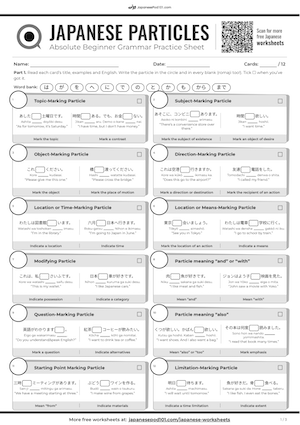
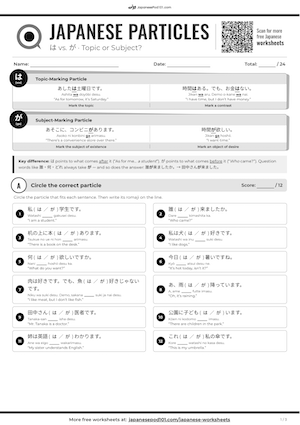
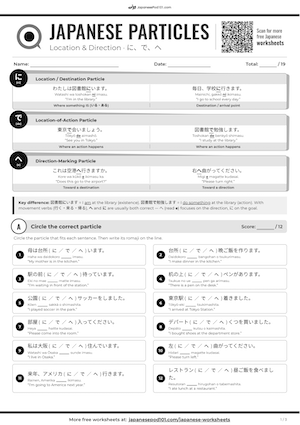
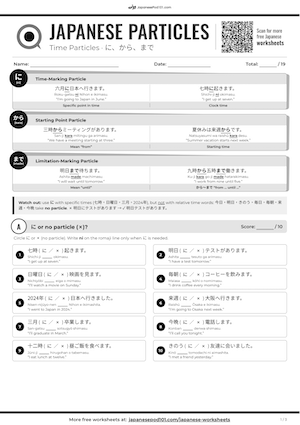
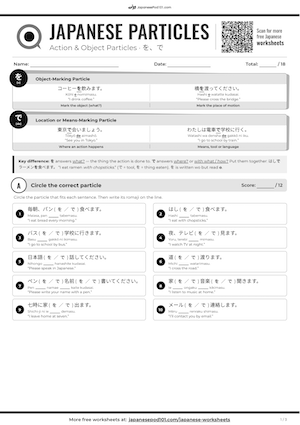
And if you want even more Japanese practice, visit JapanesePod101’s collection of free Japanese worksheets.
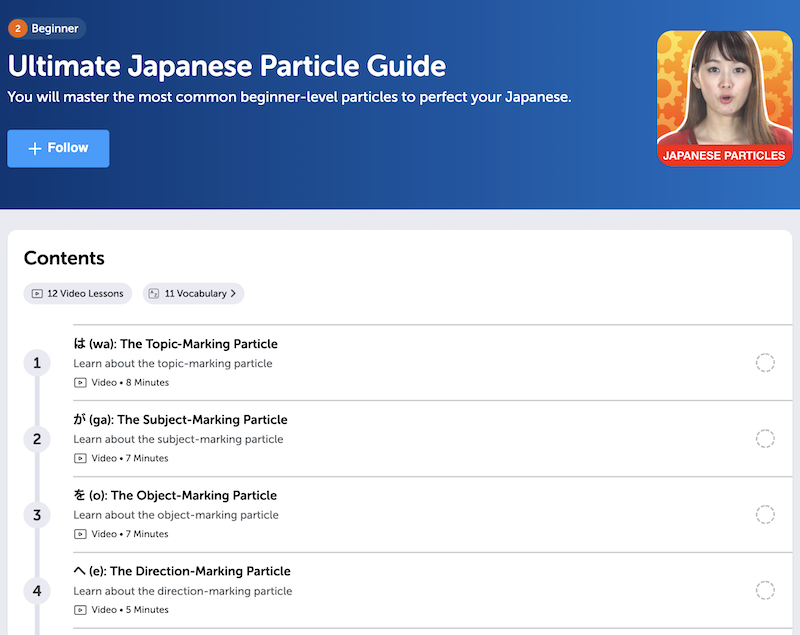
If you don’t yet know much about particles… or want to refresh your memory.
Well, there’s a whole Japanese particle course here at JapanesePod101: Ultimate Japanese Particle Guide.
In just 12 short video lessons, our Japanese teachers teach you the 12 most common particles. And you can access this course for FREE with a FREE Lifetime Account and our 7-day free trial.
New to JapanesePod101? Welcome!
JapanesePod101 is a time-tested Japanese learning program teaching since 2005.
Unlike other apps, you learn Japanese through conversations between real native speakers. Just press play on a lesson, absorb a conversation, get it explained and start speaking in minutes. We’ll take you from lesson 1, to 2, to 3… until conversational fluency.
So, if you’re interested in learning Japanese, sign up for a FREE Lifetime Account today.
First, make sure you know how particles work. Second, take our Japanese particle practice course (see above). Then, test your understanding with Japanese particle practice exercises. Finally, try using those same particles in sentences of your own.
With JapanesePod101’s Ultimate Japanese Particle Guide, you’ll learn how to use Japanese particles through dedicated online lessons. You can also download our free practice PDFs to reinforce what you’ve learned.
Sign up for a FREE Lifetime Account at JapanesePod101 to get our Japanese particle practice exercises and quizzes.
Instead of memorizing definitions, get as much practice as possible. For example, if you struggle with は and が, practice using them in different sentences. Our dedicated resources above will help you focus on the particles you struggle with most.

